Last year (or two!) has gotten us to stop and smell the roses. Isolation, long walks, home-cooked meals- all have subconsciously made us ponder on the tiny decisions we make in our everyday life. Health and nutrition often take a back seat when you are running to catch the train and a fresh donut seems to be the most convenient grab-and-go breakfast on your commute. But when commute is no longer a part of your life, and food delivery no longer seems like the safest option (nor the most economical), you inadvertently turn to your own kitchen- turn on that stove and figure out ways to ward off those hunger pangs.
The pandemic for me has been a journey into food. What started as perfecting my comfort Indian food- rice, “round” rotis and curries, somewhere transitioned into experimenting with different cuisines and ingredients. I rekindled my love for baking (as did the rest of the world). I discovered food bloggers/ vloggers whose work I enjoyed and finally began to think of food as less of a task and more of a means for nourishment. Looking back on this journey, it is difficult to identify the people, factors and environment that has played a key role but some do definitely stand out.
The People

Sadia from Pick Up Lime– Afghan by ethnicity, Canadian by birth and calling Netherlands home at the moment, Sadia is truly a global citizen. And her youtube channel with millions of followers from across the world is a testimony to that. Her recipes helped me reach the realization that vegan food could actually be delicious (!!!) and extremely nourishing. Her calm and patient voice, her principle of eat-everything-but-in-moderation and her emphasis of using whole food ingredients, makes you reflect on what you put on your plate and be more intentional about it. Putting her knowledge as a dietitian in practice, Sadia advocates for the plate method through her recipes, ensuring that they are nutritionally balanced.

Alice Waters: A pivotal figure in the farm to table movement, Alice Waters owns Chez Panisse- a restaurant in Berkeley, California. I watched her Materclass and fell in love with the detail and simplicity in her approach. It made me realize that food is so much more than the end product. It is also about the ingredients- where they come , the season they are harvested, how organically they are grown. The beauty of her approach lies in the way she takes the simplest of ingredients and puts together a flavorful meal, all the while stressing over the quality of the produce and tiny details in techniques- the timing, the temperature, and a well stocked pantry. To quote her:
“Here is how I cook: First I’m at the farmers’ market, looking for fruits and vegetables that are perfectly ripe and just picked. I’m not necessarily thinking about how the ingredients will go together, and I don’t know yet what I’m going to cook—I’m just responding to what I’m finding. I’m letting my senses lead me: smelling the garlic, tasting the pungency of the radishes, feeling the firmness of the apricots. And when I do finally start imagining how the ingredients relate to one another, I’m improvising—trying to capture that moment in time.”
Alice Water Teaches the Art of Home Cooking
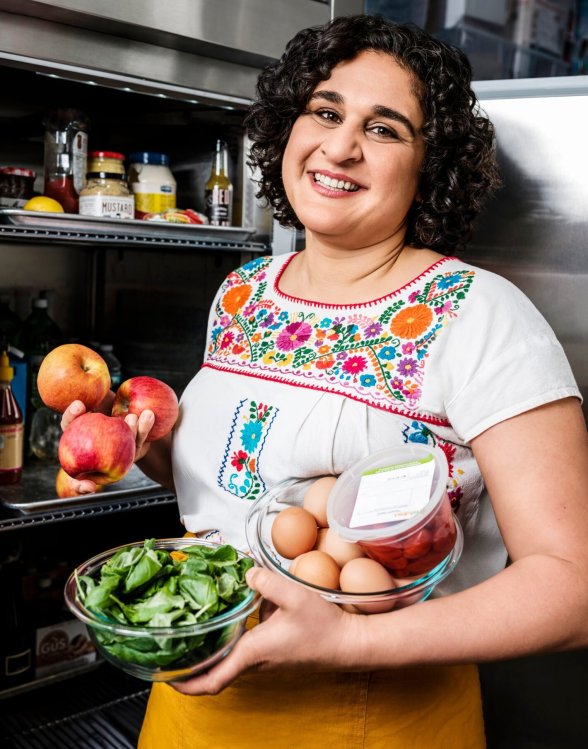
Samir Nosrat: If you were to own one cookbook, it would be “Salt, Fat, Acid, Heat” by Samin Nosrat. Although it doesn’t read like a conventional recipe book, it does have gems of recipes across the four chapters. Samin focuses on mastering the four elements of cooking (as the title suggests) and getting a grasp on the importance that each play individually and in tandem with each other. Who would have thought that swapping olive oil for sesame oil in your Chinese cooking, or adding that slight bit of tang to your food, or a sprinkle of extra salt, can make the world of difference to your final dish. Her netflix docu-series is an equally enjoyable journey into food, culture and cuisines. She inspires you to ditch the recipes, adhere to the basics and experiment in your kitchen.
Adding versus Subtracting
One of the principles to healthy eating that has proved to be sustainable in the long run is asking the question- What would you add to your plate rather than remove from your plate? Eliminating certain types of food, which is a common practice if you are part of a diet, works in the short terms but ends up feeling quite restrictive. Instead, if you tell your self that it is okay to have that spoon of sugar in your coffee, as long as you added greens to your lunch plate and fruits in your snacks. It fosters a healthy relationship with food without any labels of whats good and bad.
Playing Hard to Get
It isn’t just humans who can play hard to get, your food can too. This is a tactic I picked up from James Clear’s book “Atomic Habit”. Clear talks about breaking bad habits by making them unreachable- quietly literally and figuratively. For instance, I recently received a gift bag of Ghiradelli chocolate squares. Given my sweet tooth and my lack of control over it, I placed the bag on the top most shelf of the kitchen cupboard. This meant that every time I had a chocolate craving I had to go through the extra effort of getting a step stool to reach it. The bag lasted for a month- which for me was the longest that any piece of chocolate has lived in my house. Similarly organizing your fridge and a pantry in a way that the nutritious products are staring at you while the not-so-healthy ones are lost somewhere at the back can go a long way in helping you make better choices.
Cooking can be a chore, and it can also be a hobby. It can be a routine, while it can also be a refreshing break from the mundane. Given how much our lives revolve around it, it is worth putting in some thought behind what we feed ourselves and building a mindset that is grateful for the nourishment it offers to our mind, and body.
 Asra Yousuf
Leave a comment