
Book by Clayton Christensen, James Allworth, and Karen Dillon.
A question that often haunts most of us is whether we are living life up to its full potential. We often wonder if we are taking up opportunities and having experiences that makes life fulfilling. As we live each day, are we focusing on what is important or simply viling away the time that’s given to us?
In all likelihood, we will never know the answers to most of these questions, but we can always learn from the wisdom of those before us- from their experiences and regrets. Clayton Christensen, popular for his theory of “disruptive innovation”, was a professor at the Harvard Business School. Over the course of his career, Christensen identified parallels between business strategy and case studies, and the way people approach living life, and went on to draw life lessons from them. For instance, Honda gained prominence in the US Market by pivoting its strategy from large bikes to smaller dirt bikes, when the former failed to compete against the likes of Harley-Davidson. Christensen takes the example of Honda to suggest that we should similarly experiment in our careers- pivot when a particular career move isn’t serving its purpose.
His book, “How Will You Measure Your Life” is written with the intention of helping people factor out their priorities and preemptively take actions to focus on them. Christensen breaks down the essentials of a life well lived into three broad categories. In a three-part series, I shall attempt to summarize my main takeaways from the book.
Finding Happiness In Your Career
Our careers are a large part of our lives. We go through years of education, slowly building our skills for a career that gives us money, happiness and a sense of purpose. On an average, we spend nearly a third of each day doing some of sort of work- be it a job or building something of your own. Hence, it is imperative to find a career that is fulfilling. When deciding on a career or contemplating a transition, some factors that should be considered are:
Hygiene & Motivation Factors
Figure out your hygiene and motivation factors. Hygiene factors are “elements of work that if not done right, will cause dissatisfaction”. Aspects of a job like compensation, status, our supervisors are hygiene factors. A great boss cannot make you feel fulfilled in your career beyond a certain point, but an incompetent boss has the power to make you feel miserable at work. Likewise, compensation beyond a certain number, hardly effects your level of motivation at a job. But if you are paid extremely low and are struggling to make ends meet, it is less likely that you will enjoy your work, irrespective of however meaningful it is.
On the other hand, motivation factors are aspects of your job that make you feel that you are making an impact. It could be a recognition of some sorts, personal growth or the sense of satisfaction from solving a challenging problem . It is when you find meaning in the work that you are doing is when you feel motivated to show up everyday with your best possible self. People often confuse incentives as a motivating factor. They often choose jobs based on the compensation offered, or the status associated with working for a particular firm, without realizing that the influence of these factors on their happiness wane away quite quickly. What matters more is whether you are feeling challenged at work, if you surrounded by inspiring people, or if you are constantly learning.
Just Try Stuff
Life often ends up being about making plans for the future and then pivoting as new experiences and insights come our way. Similar should be the case with careers. Choosing the right career is about balancing deliberate strategy and unanticipated alternatives. Even though we might be working towards a goal, we should always question our assumptions and rethink our plans. For some a career in medicine might seem ideal in high school, given the prestige and strong sense of purpose it offers. But as they grow into mature adults, and factor in new data points – the long career path to becoming a doctor, the strenuous hours, the stressful nature of the job, it is okay to question your childhood dreams, change your priorities and pivot your plans.
Careers can never be built in theory. What might seem fulfilling from the outside, might not live up to its expectations in realities. It is crucial that you try as many opportunities as you can until something clicks, until you come across something that you believe is meaningful, and your skills, interest and priorities pay off.

Resource Allocation
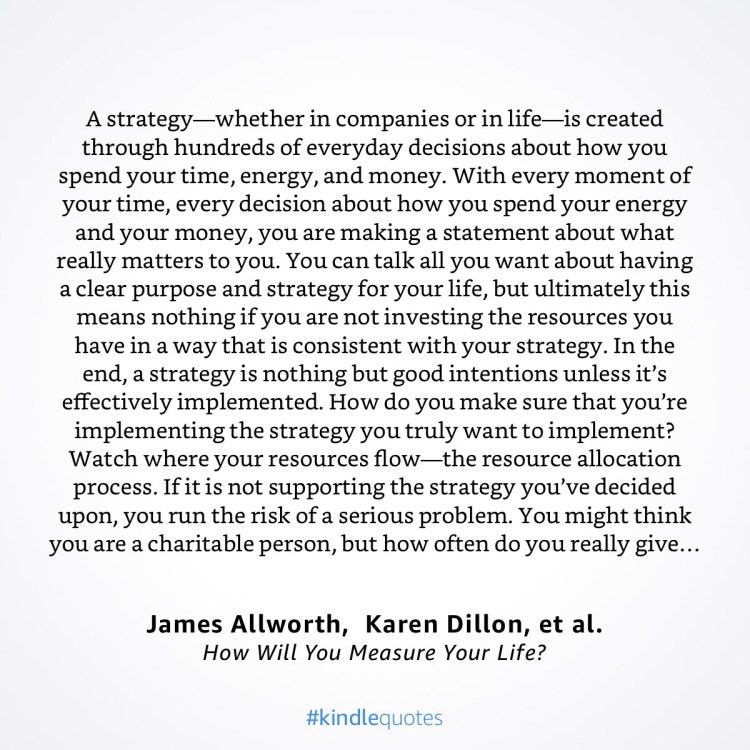
Dreaming of an ideal career is one thing, landing yourself in one is a completely different ballgame altogether. And that’s where ‘resource allocation’ comes in. The way you spend your time, money and energy (i.e. resources) reflect your priorities. The allocation of your resources should be consistent with the person you aspire to be. For instance, to build a career as a data scientist, you should start with aspirations and follow it up with a plan to dedicate a portion of your time and energy to gain skills needed for the job. If your goals are not followed by actions, they simple remain unfulfilled dreams.
Other Recommended Readings:
How to Pick a Career (that Actually Fits You) by Tim Urban
Think Again- Part III: Collective Rethinking: Creating Communities of Lifelong Learners by Adam Smith
 Asra Yousuf
Leave a comment