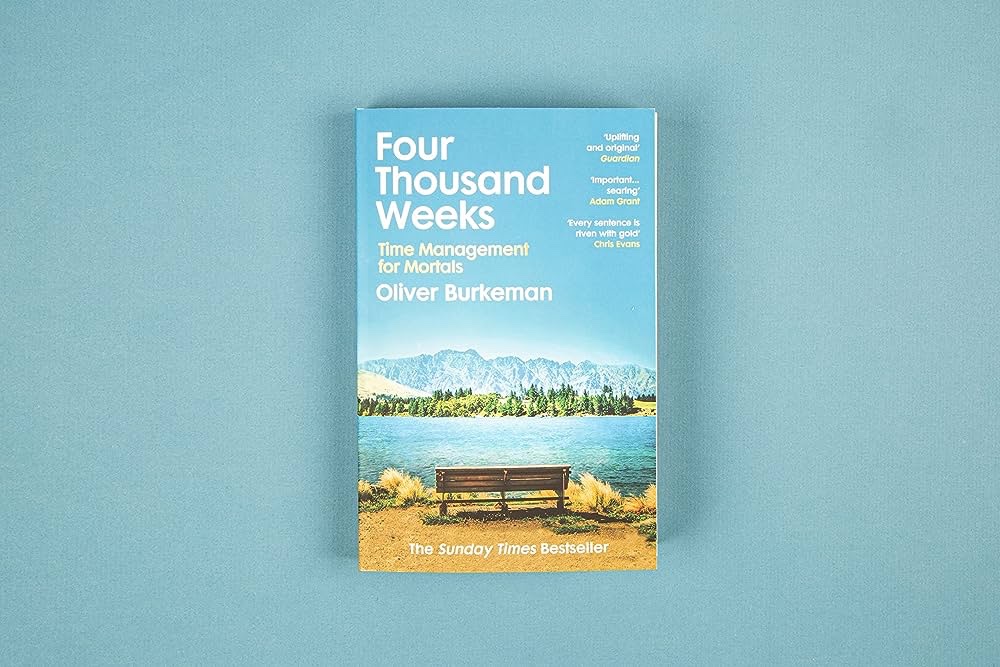
Author: Oliver Burkeman
How do you visualize time? In minutes? Hours? Days? Weeks? Months? Or Years? As a kid, I would divide my study hours into 15 minute chunks- 15 minutes to cover one page of a lesson. So if a History chapter had 8 pages, it would take me two hours to fully absorb what it had to offer, to the extent that I could answer any question that came from it in a test. My current approach in life has been in weeks- from one Sunday to the next, not knowing what the future holds (or rather pretending not to be overwhelmed by it). Some days do end up with the vibe of “one day at a time”, when life gets the better of your emotions.
But why am I rambling on about my perception of time?! We live our lives by the clock and the calendar. Together they dictate what we choose to do. We all have a sense of our finitude and it consciously or subconsciously influences the choices we make. No wonder we come across questions like- “What would you do if you were to live forever?” Or “What would you do if you were to die today?”
Four thousand weeks is not your usual time management book. It does not give you tips and tricks to squeeze out the maximum value from every second of your existence. Rather it challenges our approach to living in the context of time and our hyper-focus on productivity. 4,000 weeks is all we have (or at least the average human does). How do we use this time in a way that is fulfilling, authentic and fun?
Burkeman uses the former half of the book to set the basis for how our quest for productivity and efficiency is a never ending cycle. But it was only in the latter half of the book that I found bits of anecdotes and thought provoking questions that stuck with me. For this summary, I am going to keep it short and talk about the following two key ideas:
On Patience
We switch tabs on our browser the moment a page takes a few extra seconds to load. We have food delivered at our doorstep within half hour. While it is extremely convenient, it is effecting our ability to be patient, to persevere and to wait for the slow results. But most good things in life take time. Burkeman talks about the 3 principles of inculcating patience in your life:
1. Develop a taste for having problems: Life is just a processs of engaging in problem after problem- giving each one the time it requires. Never will there be a time when you do not have a single problem to deal with. Accept that problems will come and go and learn to appreciate the challenge they bring.
2. Embrace radical incrementalism: Problems are never solved in one sweeping streak. It is usually the process of taking one small step every day towards building the solution. Acknowledge the slow and steady route to figuring it out.
3. Originality lies on the far side of unoriginality: Start with walking on the path paved by others. Don’t be frustrated by the notion that all you are doing is copying. Don’t be bothered by creating anything new and authentic. If you keep walking long enough, slowly but gradually you will start to carve out your own path through the knowledge you have amassed on the journey.
On being insignificant

A prominent source of anxiety that a lot of us have is from our quest to seek something bigger than ourselves- the meaning of life, the purpose of our existence. The truth, however, is that in the grand scheme of things your life and your time on earth is hardly going too matter. Even if you invent something “life-changing”, you will be a blip in the passage of time, a century or two later. Liberate yourself of this notion that what you do with your time matters to the world at large and embrace your insignificance. Burkeman outlines 5 questions he encourages us to ask to separate us from pursuit of meaning and purpose and encourage us to live every moment in a way that feels ideal.
1. Where in your life or your work are you currently pursuing comfort, when what’s called for is a little discomfort? Does this choice diminish you or enlarge you?
2. Are you holding yourself to, or judging yourself by standards of
productivity or performance that are impossible to meet?
3. In what ways have you yet to accept the fact that you are who you are, not the person you think you ought to be?
4. In what areas of life are you still holding back until you feel like you know what you’re doing?
5. How would you spend your days differently if you didn’t care so much about seeing your actions reach fruition?
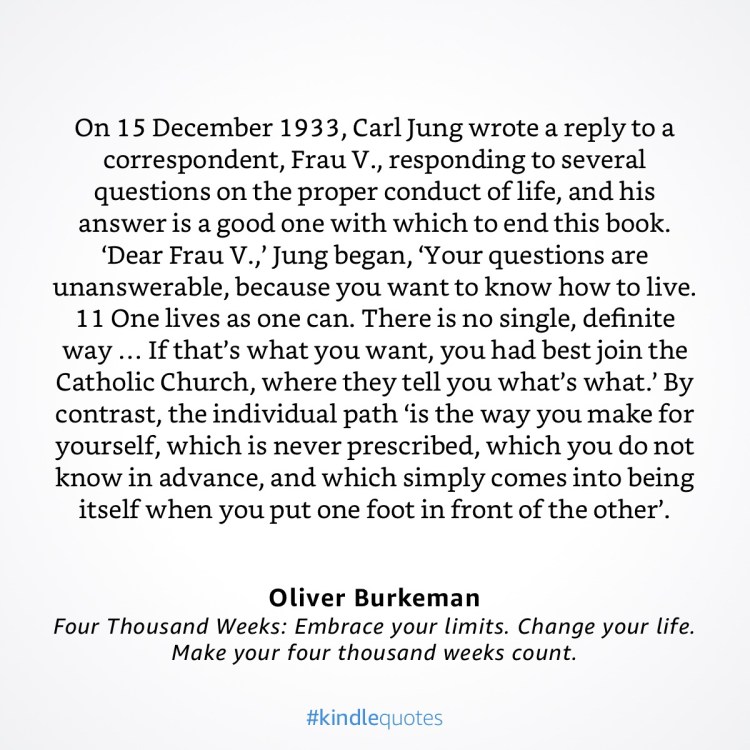
So if there is no large overarching purpose to your existence, then what do you structure your life around? Just “do the next right thing”.
 Asra Yousuf
Leave a comment